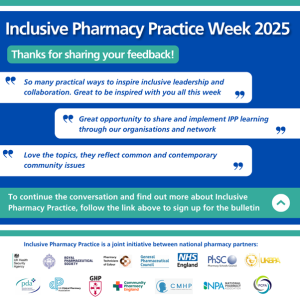

On the 26th of November 2025, speakers coordinated by the Pharmacy Schools Council took part in a session entitled Fairer Futures in Pharmacy Education, alongside speakers from NHS Workforce Education and Training.
You can view the recording of the session here: Fairer futures in pharmacy education (26 Nov) on Vimeo
Colleagues across England attended and heard from Victoria Tavares from Manchester University, and Natalie Lewis from Aston University, alongside TiJesu Akeredolu from Pharmacy Foundations. Three presentations were also given by different regional teams within NHS WT&E, the Northwest, Southwest, and Midlands Teams.
Attendees were inspired to start looking into awarding and attainment gaps following the initial work carried out by the GPhC, and I think we all want to make sure that we are giving full credit to all of our students for their hard work.
Victoria’s work dug deeper into differential achievement at the University of Manchester, to see which factors were affecting the outcomes of their students.
We heard about the different experiences of students and considered the differences between students who move for university and live with fellow students versus those who stay at home and commute. In their research, it was found that students who lived with other students had a higher average end of year mark compared with students who didn’t, because for example they had caring responsibilities or lived with family. More students are choosing to stay at home, due to costs, and as education providers we need to reflect on how best to support this growing number of learners.
They investigated whether students felt prepared for their higher education journeys, and if they felt a sense of belonging for their chosen Higher Education Institution. We feel as though we know some students are less likely to ask for help, but the research conducted at Manchester looked into this formally. Younger students, female students, and students who lived with others all reported a higher sense of belonging, and this fed through to higher average end of year marks too. The original article that Victoria’s presentation was based on is here for further reading.
The presentation from the NHSE Northwest team introduced a structured training programme aimed at improving cultural competence and promoting inclusive work environments among pharmacy supervisors. Building on essential supervision principles, the programme incorporated theoretical foundations, practical applications, and implementation guidance, complemented by pre-work activities and resources focused on effective supervision, neurodiversity, and cross-cultural communication. The sessions included peer discussions, analysis of real-world case studies, and coaching to explore topics such as reasonable adjustments, psychological safety, and the design of inclusive learning experiences. Participants received support in developing actionable plans and were equipped with key NHS England resources to assist ongoing implementation. The programme involved 31 supervisors through both face-to-face and online sessions and provided access to a central resource library to facilitate continued professional growth.
Natalie Lewis shared her work on awarding gaps at Aston University, and the challenges of looking at gaps when some student groups are very small. Aston University is a widening participation university, as is the University of Lancashire where I am based, and most of their students come from the lowest two socioeconomic groups. We are all trying to work with the data at our institutions to feed back to the GPhC and feed forward to colleagues to make sure we are meeting the needs of 21st century students, and having dynamic data can help us to make changes when needed. We can get hung up as academics on having big enough numbers to achieve statistical significance, but working with smaller numbers can be impactful sometimes as each of those numbers is a student who could be the first in their family to attend higher education. In her work Natalie found no awarding gaps across ethnicity, or across socioeconomic status, and she puts it down to the widening participation work that they have been doing.
The session by the NHSE Southwest team provided an overview of the Southwest Inclusive Pharmacy Practice (IPP) Manifesto and how it had been used to support more inclusive pharmacy trainee inductions. Participants were introduced to the manifesto’s aims to improve belonging, reduce health inequalities, and strengthen inclusive leadership and workforce practices. The session shared learning from the Clinical Fellow project, examples of induction in practice, and highlighted the importance of reasonable adjustments. It also showcased the PWDS Neurodiversity Workforce Champion programme, which had trained 23 champions and expanded neurodiversity awareness across the Bristol area. Overall, the session helped attendees understand how the IPP principles had been applied regionally and what steps could further enhance inclusive induction. You can find out more about the Workforce Champion programme here: Neurodiversity Workforce Champion Training – PWDS
TiJesu Akeredolu shared an update with us about the work of Pharmacy Foundations, and specifically their Scholarship programme. Pharmacy Foundations work with several HEIs across England to support Black pharmacy graduates during their foundation training year, alongside broader training programmes and events. The initial work done by the GPhC inspired them to set up the programme, which was originally just for community trainees, but has now expanded to cover other sectors as well. The graduates who join the programme get to work with a mentor, alongside getting additional training resources, and it is that work with mentors from similar backgrounds, or with similar experiences, that is really helping these graduates get the most from their training year, and also helping them to succeed in the registration assessment.
The presentation from the NHSE Midlands team examined the experiences of OSPAP graduates during their foundation training year in England. It highlighted that while OSPAP trainees often performed strongly in registration assessments, they faced challenges linked to unclear supervisor awareness of the OSPAP curriculum, difficulties with the Oriel application system, visa delays, and limited preparation for situational judgement tests. Trainees valued supportive supervisors, inclusive learning environments, and strong peer networks, though the level of support varied between hospital and community placements. They also encountered challenges adjusting to UK workplace culture and communication styles. Systemic inequalities – particularly around prescribing training pathways – created concerns about a developing two‑tier system. Despite these obstacles, OSPAP trainees demonstrated resilience and contributed positively during training. The presentation recommended improving supervisor preparation, strengthening application support, establishing a national peer forum, standardising learning opportunities, and addressing structural inequalities in prescribing pathways.
After the event, Victoria Tavares said she felt it had gone really well, and that the PhSC Student Success Group would like to be more involved in future IPP events.
I found our event really inspiring and will share what I learnt at different sessions across the week with university colleagues and students alike. Working in this area can feel isolated, it’s good to share successes with other interested people – if you have work to share, then please join us for future events.
Cathryn Brown, Senior Lecturer in Pharmacy Practice, University of Lancashire, with contributions from Sejal Gohil, Foundation Pharmacy Training Programme Director, Midlands Pharmacy Team and Navneet Gill, Foundation Pharmacy Training Programme Facilitator, Midlands Pharmacy Team, NHS England.